
Home / Technical Guides / Iron Pipe Fittings
Buyer’s GuideIron Pipe Fittings: Types, Functions and How to Choose
Iron pipe fittings are the connecting components of an iron pipe system: they change direction, create branches, join straight runs, change size or close a line. For small and medium threaded pipe, the most common fittings are made from malleable iron and supplied black or hot-dip galvanized.
Quick Answer
Choosing the right iron pipe fitting means matching five things to the installation specification:
- Fitting type — elbow, tee, socket, union, nipple, bushing, plug, cap, cross and so on
- Nominal size — e.g. ½″, ¾″, 1″ (TSP manufactures ¼″ to 6″)
- Thread system — BSP/ISO 7-1 or NPT; the two must not be mixed
- Design standard — ASME B16.3, EN 10242, JIS B 2301 or SNI 139:2024
- Finish — black or hot-dip galvanized
Types of iron pipe fittings and what they do
Each fitting type has one main job. The table summarises the types in TSP’s malleable iron range:
| Fitting type | Main function | Typical use |
|---|---|---|
| 90° / 45° elbow | Changes pipe direction | Turns in water or fire lines |
| Street elbow | Elbow with one male and one female end | Tight spaces, fitting-to-fitting |
| Tee & reducing tee | Creates a branch (equal or reducing) | Branches to outlets or sprinklers |
| Cross | Four-way branch | Distribution runs |
| Socket & reducing socket | Joins two straight pipes (equal or different size) | Extending a run |
| Union | Joint that can be disconnected | Next to pumps, meters or valves |
| Nipple & hexagon nipple | Short piece with male threads on both ends | Joining two female fittings |
| Bushing | Reduces a thread size | Adapting from larger to smaller size |
| Plug & cap | Closes a pipe end or fitting outlet | Spare outlets, pressure testing |
| Locknut, back nut, floor flange | Locking and mounting | Securing joints, mounting to floor or wall |
Types listed follow TSP’s product range.
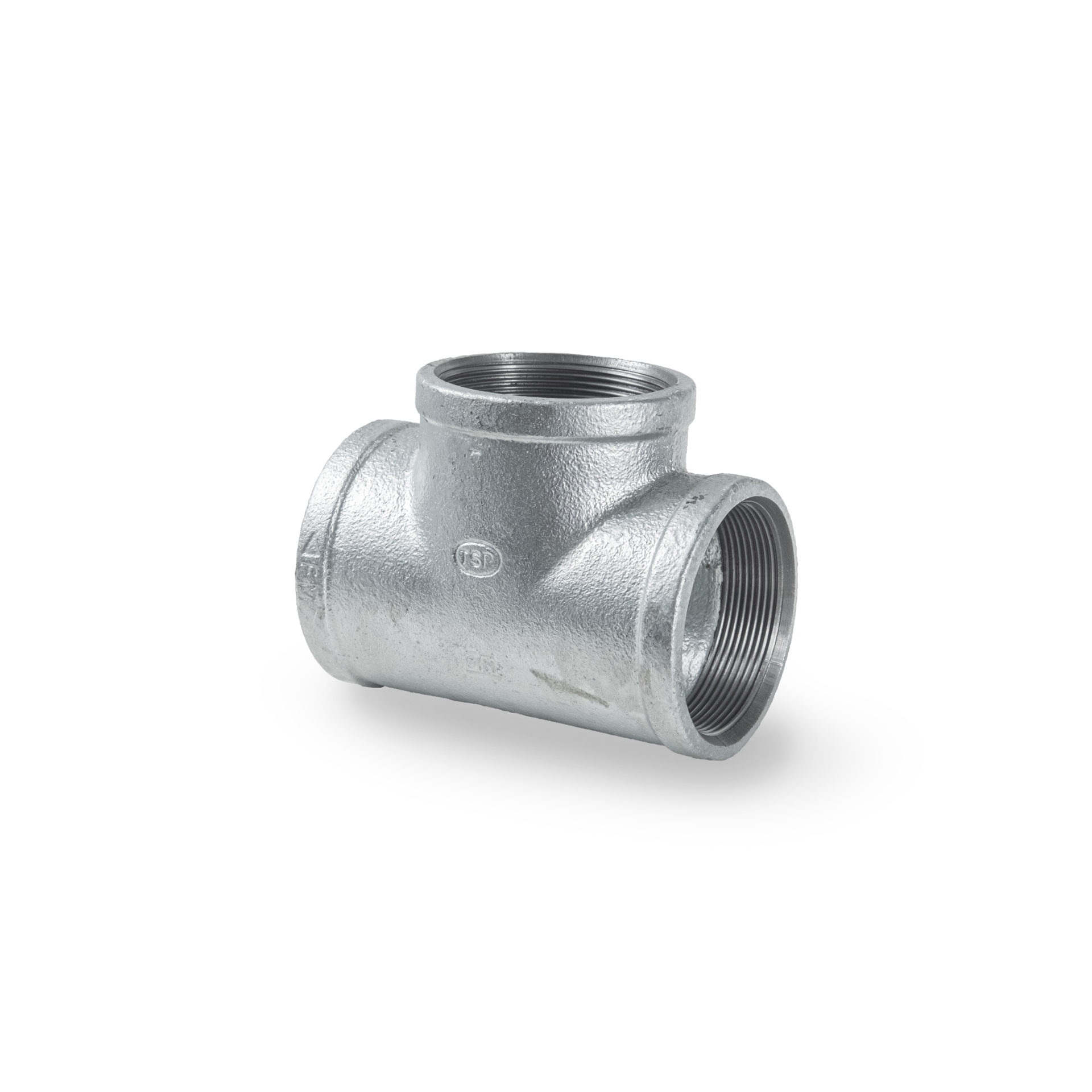
Product detail — for example Tees Banded FIG 130, 90° Elbows Banded (ASME) or Union Flat Seat FIG 330 — is in the product catalogue.
Material: why threaded iron fittings are usually malleable iron
Ordinary grey cast iron is hard but brittle. With malleable iron, the casting is re-heated in an annealing cycle that changes its carbon structure, making the material ductile — far less prone to cracking when threaded, tightened or loaded. That is why malleable iron is the standard material for threaded fittings.
At TSP, annealing is done in-house in Semarang, and tensile testing is applied with a minimum of 350 N/mm² and minimum elongation of 6% (see Quality Control).
Black vs galvanized iron fittings
Finish is a separate attribute from fitting type and standard. Black means no zinc coating; galvanized means the same fitting with a hot-dip zinc coating. TSP checks coating thickness with an Elcometer — 10 spots per sample, minimum 70 µm. See Black vs Galvanized Malleable Iron Fittings.
Sourcing iron pipe fittings for a project?
Send type, size, standard, finish and quantity — TSP’s team replies on WhatsApp during business hours.
How to choose the right iron pipe fitting
- Pick the fitting type from the function on the drawing (turn, branch, straight joint, disconnect, close).
- Match the nominal size to the pipe, in inches (½″, ¾″, 1″) or DN (15, 20, 25).
- Match the thread system to the pipe and other components — BSP/ISO 7-1 or NPT. Different threads will not seal even at the same size.
- Follow the specified standard: ASME B16.3, EN 10242, JIS B 2301 or SNI 139:2024 depending on the market.
- Select the finish: black or galvanized, as specified.
- Ask for documents: certificates (FM, UL, DVGW, SNI as required) and technical data from the manufacturer.
Why buy from the manufacturer
PT Tri Sinar Purnama has manufactured malleable iron pipe fittings in Semarang, Indonesia since 1983. Pattern making, casting, annealing, galvanizing, threading and packing are done in-house across two production sites totalling 60,000 m², with an annual capacity of 15,600 tons. Every product is leak-tested at a minimum of 7 bar before packing, and threads are checked with plug and ring gauges.
TSP sells under two own brands — G-Brand (since 1983) and TSP Brand (since 1990) — both made in the same plants. Certifications are listed on the Certifications page.
Conclusion
The right iron pipe fitting is a combination of type, size, thread system, standard and finish that matches the specification. The most common mistakes are mixing thread systems and ignoring the standard a project calls for. Start from the drawing, then check all five parameters before ordering.
Talk to TSP about your fittings
Our team helps match fitting type, standard and size to your project.
Frequently Asked Questions
What are iron pipe fittings?
Iron pipe fittings are components that connect iron pipes to change direction, branch, join, reduce size or close a line. Threaded fittings are usually made of malleable iron.
What are the main types of iron pipe fittings?
Common types are 90° and 45° elbows, street elbows, tees, reducing tees, crosses, sockets, reducing sockets, unions, nipples, bushings, plugs, caps, locknuts, back nuts and floor flanges.
What is the difference between black and galvanized fittings?
Both can come from the same malleable iron casting. Galvanized fittings have a hot-dip zinc coating; black fittings do not. The project specification decides which finish to use.
Can BSP and NPT threads be connected?
This is not recommended. BSP (ISO 7-1) uses a 55° thread angle and NPT a 60° angle, with different threads per inch at several sizes, so the joint will not seal properly.
What sizes does TSP manufacture?
TSP manufactures black and galvanized malleable iron fittings from ¼″ to 6″. Available sizes vary by fitting type and figure number.
Related Guides
Data sources: trisip.com Products, Quality Control, Manufacturing and About pages; TSP product catalogues.